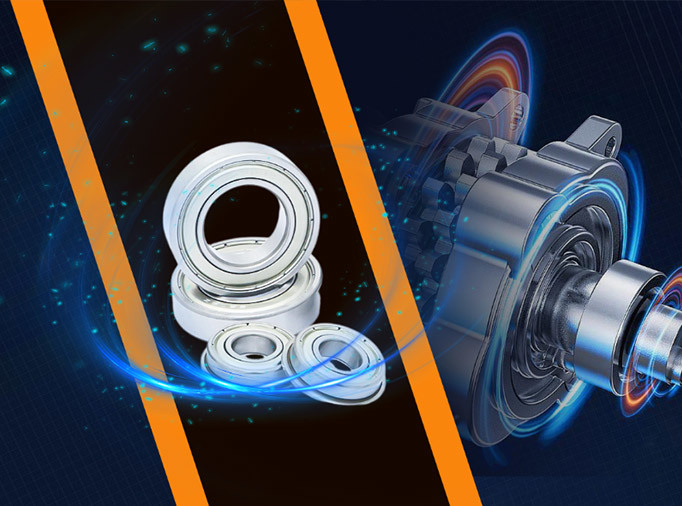
Ningbo Zhenhai Jinjinnaichi (NJJ) Bearing Co., Ltd. is a national high-tech enterprise specializing in the production of small-sized thin-wall low-noise deep-groove ball bearings.
The company insists on relying on technological progress, adopting advanced technology and introducing advanced equipment, and is committed to the development and development of low noise bearings.
Now has more than 130 automatic production lines, equipped with a full set of advanced bearing testing equipment, has a full set of automatic assembly line, the use of automatic line in one step.
At present, the company selects the high-quality supplier resources in the industry, supporting the supply of bearing steel, steel ball, cage, dust cover and a series of raw materials
How Industrial Robots, Cobots, Mobile Platforms and Humanoids Are Redefining Demand for Precision Bearings
Time:
2026-11-13
The robotics sector is entering a transformative era that stands to reshape global requirements for precision bearings and motion hardware fundamentally. For many decades, industrial robots were mostly associated with automotive production lines, welding stations, palletizing cells and repetitive mass-manufacturing workflows. Bearings fulfilled an essential yet relatively specialized function within these devices, supporting rotary joints, servo drives, gear assemblies and reducers to deliver controlled, accurate motion.
This landscape is undergoing fast-paced change.
Robotics is breaking out of the boundaries of classic factory automation, branching into collaborative manipulators, autonomous mobile robots, medical robotic platforms, lab automation hardware, agricultural machinery, inspection devices, quadruped robots, powered exoskeletons and, increasingly, humanoid systems. Meanwhile, breakthroughs in artificial intelligence, sensing modules, battery technology, motors and precision actuation enable robots to achieve greater autonomy, improved mobility and the ability to execute a far wider spectrum of tasks.
This shift deserves close scrutiny from bearing producers. At its core, every robot relies on controlled mechanical motion. Any motion executed by a robotic arm, wrist, drive wheel, dexterous finger, shoulder joint, knee assembly or standalone actuator depends on regulated rotary or linear movement. Bearings therefore form a foundational component that defines overall robotic performance. They directly govern positioning accuracy, structural stiffness, load capacity, operating speed, frictional loss, power draw, vibration levels, motion repeatability and total service lifespan.
As robot hardware trends toward miniaturization, lighter weight, faster operation and smarter control, the performance thresholds for supporting bearings keep rising. In turn, robotics may evolve into one of the highest-value growth verticals for the worldwide bearing industry over the coming decades, all the way to 2050.
Robotics already constitutes a sizable industrial market
The foundation of this growth lies within the established industrial robot market. According to the International Federation of Robotics, over 542,000 new industrial robots were installed globally in 2024, bringing the total worldwide operational fleet to roughly 4.66 million units. Annual deployments have stayed above the half-million mark for multiple years running, proving that robotic automation has moved well beyond a niche engineering solution.
Asia remains the dominant region, accounting for approximately three-quarters of all newly installed units. China alone captured more than half of global industrial robot installations in 2024. Electronics manufacturing, the automotive industry, metalworking and machinery production continue to be the top application fields. Even so, adoption is steadily spreading into food manufacturing, pharmaceutical production, warehousing and distribution, general fabrication, as well as small and mid-sized enterprises.
The market is accordingly growing more diverse. Future expansion will no longer stem mainly from adding extra robotic stations inside automobile factories. Instead, growth will be driven by robotic penetration into sectors and use cases that have historically adopted very little automated equipment. This opens up a far broader commercial opportunity for bearing suppliers and makers of power transmission components.
Beyond conventional articulated industrial robots
The classic six-axis articulated robot is still the most widely recognized automation workhorse on factory floors. These systems commonly carry out welding, component assembly, surface coating, material transfer, machine tending, quality inspection and pallet-handling tasks. Each major joint incorporates intricate bearing configurations engineered to withstand combined axial, radial and tilting loads while retaining exceptional rigidity. Even so, several newer robot categories are expanding at a rapid clip.
Collaborative robots, or cobots, represent one of the most impactful innovations in modern factory automation. Unlike traditional industrial robots, which usually operate behind protective safety fencing, cobots are engineered to work side-by-side with human operators. This imposes distinct mechanical requirements. Cobot joints typically need to be lightweight, compact, low-noise and highly responsive to torque variations. Minimal friction carries special significance, as onboard controllers often leverage torque feedback to detect unintended collisions or physical contact with human users. Joint hardware for cobots tends toward high integration: a single compact housing may pack a servo motor, position encoder, electromagnetic brake, precision reducer, torque sensor and full bearing set. This creates promising commercial prospects for manufacturers specializing in high-precision bearings.
Autonomous mobile robots form another high-growth segment. These mobile platforms are deployed at scale inside warehouses, distribution hubs, manufacturing plants, medical facilities and airport terminals. Unlike fixed-position robotic arms, AMRs travel continuously across their working environment, which creates a unique set of bearing specifications. Demand spans wheel drive bearings, motor bearings, gearbox components, steering assemblies, caster bearings, conveyor rollers and lifting mechanisms. While the bearing value per individual AMR may be lower compared with a complex articulated manipulator, the total production volumes can be substantially larger.
Medical robotics is another fast-expanding frontier. Surgical robotic platforms, rehabilitation devices, diagnostic machinery and automated laboratory instruments demand outstanding precision and reliability. Within these applications, bearing performance frequently takes priority over unit cost. Ultra-low friction, suppressed noise, limited particulate release, clean lubrication formulas and ultra-smooth motion profiles become non-negotiable design criteria. As automation continues to penetrate healthcare workflows, medical robotics may emerge as one of the most technically challenging markets for precision bearing vendors.
The humanoid robotics outlook
Humanoid robots represent both the largest long-term unknown and arguably the biggest upside opportunity. At present, humanoid platforms make up only a tiny fraction of the broader robotics market, with merely tens of thousands of units deployed in early commercial trials.
Nevertheless, capital investment flowing into this track is considerable. Developers including Tesla, Figure AI, Apptronik, Agility Robotics, Unitree, UBTech, AgiBot and many other teams are advancing robots capable of executing human-style physical labor. Their long-range vision is not limited to machines built for a single predefined task. The end goal is general-purpose robotic systems that can function naturally within spaces originally designed for human activity — a goal that brings sweeping changes to mechanical design principles.
A single humanoid robot may feature dozens of independently driven joints. The neck, shoulders, elbows, wrists, hands, individual fingers, torso, hips, knees and ankles can all require dedicated actuators. Depending on the mechanical layout, a humanoid system can possess anywhere from 25 to over 60 degrees of freedom, and dexterous robotic hands add further independent motion axes. From a bearing standpoint, humanoid platforms stand to become among the most bearing-intensive mass-produced machines ever developed. Once bearings within joints, drive motors, reducers and auxiliary moving parts are tallied, an advanced humanoid design could reasonably require 60 to more than 100 rolling bearing positions.
This does not imply that every future humanoid will follow this exact hardware layout. Some designs may lean more heavily on plain bearings, bushings, direct-drive architectures, roller screw assemblies or fully integrated actuator solutions. Even so, the sheer potential market scale cannot be overlooked. Should humanoid manufacturing eventually ramp up to millions of units each year, the resulting pull for precision bearings will be immense.